Expanding Talent Acquisition Beyond Borders
In the current global workforce, companies are not able to just stay in local bounds, they have to search for all necessary professionals beyond the borders. Multi-language recruiting has become fundamental in tapping both Latin-American and Eastern-European talent, especially in logistics and trucking companies like Leadgamp. These areas of the world are providing the active, multilingual workforce that is willing to join stable international employers.
With the correct recruiting strategies, companies can build stronger talent pools, speed up the time-to-hire, retain employees longer, and become more diverse and global-ready.
Why Latin-American and Eastern-European Talent Pools?
The Latin-American and Eastern European regions are home to the most hard-working, skilled, and dedicated employees. These regions are primarily preferred in logistics, trucking, warehousing, IT, and customer service sectors. The main reasons employers select these regions are their time-zone compatibility with the U.S., similar cultures, and lower costs.
- Latin-American talents usually are the students with a very high level of English, as well as digital devices and communication challenges.
- Eastern-European talents bring a dividend of technical mastery, to a strong ethic of hard work, and a great deal of bilingual or multilingual people.
For companies like Leadgamp, the expansion is not just only about growing, but it is also about the establishment of a high-performance, multilingual infrastructure that is able to easily meet international requirements.
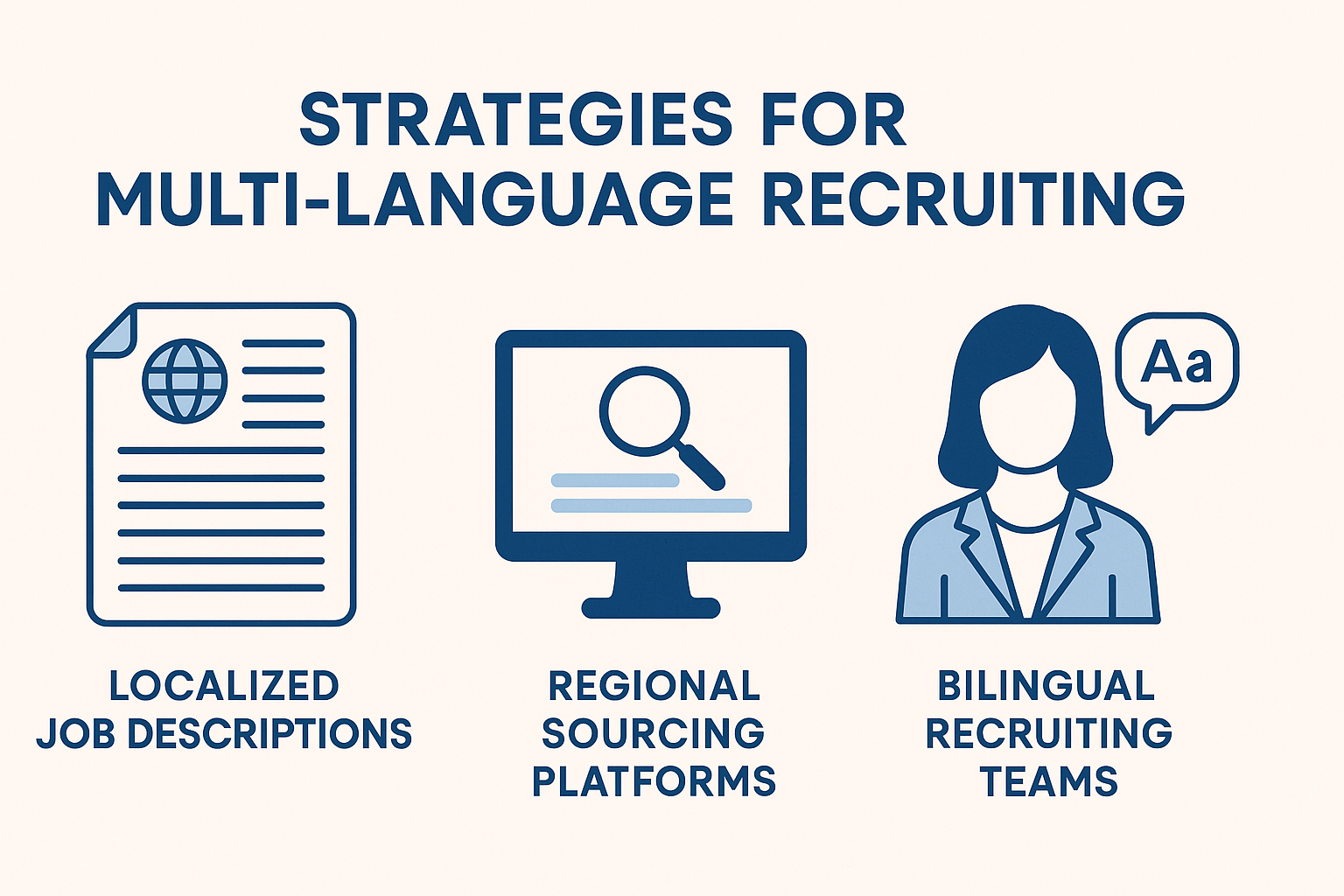
Strategies for Multi-Language Recruiting
Creating a successful international talent pipeline requires recruiting methods that are multi-language. Nevertheless, such methods should be customized to suit each region. The following are proven strategies that work.
Localized Job Descriptions
Equally important as the job ads translations is their localization. Localization goes beyond job responsibilities, the way of speaking, and the benefits which are shared to the cultural expectations. For instance, Eastern European candidates are likely to focus on job security and career advancements mostly, while Latin American candidates choose flexibility and company values as the first preferences — especially in industries like transportation, where working conditions and trust in the employer matter deeply.
- Translate job postings into local languages (e.g., Spanish, Portuguese, Polish, Romanian).
- Use culturally relevant keywords and benefits.
- Avoid U.S.-centric references that may confuse global candidates.
Regional Sourcing Platforms
LinkedIn should not be the only platform that you use. Many of the talented candidates in Eastern Europe and Latin America use local platforms such as:
- Bumeran and Computrabajo (for Latin America)
- Pracuj.pl, Jobs.bg, NoFluffJobs (for Eastern Europe)
By posting jobs on these local platforms, the effectiveness of multi-language recruiting is increased significantly.
Bilingual Recruiting Teams
Employing bilingual or multilingual recruiters who have an understanding of the Latin-American and Eastern-European cultures is truly transformational. They will be able to build rapport, ask better questions in interviews, and walk the candidates through the hiring process without language barriers.
At Leadgamp, we observed that hiring a bilingual onboarding specialist not only helped to gain a candidate’s trust but also considerably cut down on miscommunication in our recruiting strategies.
Adjusting the Candidate Experience for Different Languages
Once you get international candidates interest, the next step is to build trust. This is achieved through the candidate experience, which like your sourcing strategy, needs to be as carefully localized.

Multi – Language Onboarding
It is advisable to have all relevant documents such as emails and contracts in both English and the candidates native language. This provides the shared information in an easily comprehensible way to the candidates and also reduces the onboarding hassle while creating an environment that respects the candidates.
Culturally Aware Interviews
Discriminatory or irrelevant questions in interviews can lead to misunderstandings of different cultures. In Eastern-Europeans, for instance, asking personal things may feel inappropriate, while in Latin America, people tend to feel close to each other.
Tools and Technology That Make It Easier
Recent recruitment platforms are no longer just repeating the same things that have been done in the past. Multi – language recruiting is commandeering new technologies like never before. Here are some that we have used at Leadgamp:
- Workable: Allows for multi-language job posts and ATS integration.
- BambooHR: Document translation for onboarding.
- Zoom + Interpreters: Ideal for multilingual interviews.
- Localized testing platforms: Helps test technical or soft skills in native languages.
Your recruiting strategies will simply be more scalable and exact when you utilize the right tools.

Leadgamp’s Case in Latin-American and Eastern-European Talent
Leadgamp was in the position of a growing trucking company in a U.S. competitive market and could only achieve goals if other hiring channels were utilized. We decided to focus on Latin-American talent for dispatch and support and Eastern-European skills for logistics planning and tech integration.
To do this:
- We developed job descriptions in two languages for every post.
- We found a recruiter fluent in Spanish, Portuguese, and Russian.
- We promoted referral bonuses targeted at international hires.
- We launched localized social campaigns aimed at demographics in Brazil, Colombia, Ukraine, and Poland.
The effects?
- Hiring costs per candidate were reduced by 32%
- Onboarding was accelerated by 45%
- Retention was over 28% better after six months.
These victories were a result of real adjustments in our recruiting strategies rather than purely applying local needs realization to a one-size-fits-all method.
Challenges in International Multi – Language Recruiting
Though the advantages far compensate the attempts, international talent pools also present some challenges:
Legal and Compliance Issues
Every state has exclusive labor and tax laws, and a different set of contract conditions. So, always consult local HR or legal experts while recruiting internationally.
Time Zone Coordination
Although there is some U.S. time zone overlap in Latin America and some parts of Eastern Europe, scheduling can still be tricky. Flexible work hours help.
Identification of Communication Ambiguity
Nuances may be lost even with bilinguals. Please confirm understanding and promote open communication from both sides.
Emerging Trends: Building Diverse Global Teams
The recruitment sector is developing briskly. Firms that take on multi-language recruitment as a principle, not merely as a tactic, will fare far better in the real future. The key trends to monitor will be:
- Remote-first recruiting: The hiring process without borders is becoming a norm
- Cultural intelligence training: Equipping teams with knowledge of working internationally promotes performance
- AI-driven translation: Autonomous translators and multi-lingual AI onboarding tools are evolving to be more accurate
At Leadgamp, our investments are directed to these tools and processes so that our teams become diverse, agile, and fully integrated worldwide.
Pro Tips for Optimizing Multi – Language Recruiting
Here’s a checklist of the top actions to take while hiring from Latin American and Eastern European markets:
| Step | Tips |
| Job Description | Translate, and localize for culture and clarity. |
| Sourcing | Regional platforms + community outreach. |
| Communication | Always, at the least, provide a bilingual touchpoint. |
| Interviews | Ensure recruiters are trained on cultural nuances. |
| Onboarding | Translate documentation and offer regional support. |
| Retention | Implement an inclusive reward system, including language-sensitive perk options. |

To wrap up : Global Talent, Local Impact
Multi – language recruiting is not just about positions being unfilled but rather the creation of a truly global and high-performing workforce. For companies like Leadgamp, the answer has been Latin American and Eastern European recruiting talent, diversifying across skillsets and capabilities at different times and in varied cultures.
Reaching these international talent pools is the right move if they are seen as adding value to the organization. This is true for companies not only in logistics but in many other fields too.