Flatbed carriers are the backbones of steel producers, fabricators, and end-users who store and ship heavy coils, beams, and plates in the Pittsburgh industrial heart. However, it has become very tough to achieve this because of the rising duties, change of tariff schedules, and fluctuating spot rates. In this article, we are going to discuss some feasible tariff adjustment techniques, actual and practical tracking tactics, and operational playbooks for the transportation of flatbed steel shipments into the Steel City. It will be written in simple language, supported by basic examples, and will include a mention of carriers like HMD Trucking without it being overly promotional.
Decoding the Pittsburgh Tariff Eco
Steel corridor of Pittsburgh is not only a geographical feature but also a segment of the craft that continues to change the rules on tariffs i.e. section 232, and flat-rolled products. Tariffs that include Section 232 on flat-rolled products and rolling antidumping duties mean that the shippers should follow and monitor every moment in the entire tariff history closely. Inability to follow the timelines might lead to budget slacks and compliance problems or sometimes would even cause delays of the shipment from the dock.
- Tariff Timeline: A time record of the changes in tariffs is crucial for any cost modeling.
- Volume Surge: Seasonal or project-based peak loads (like pre-winter stockpiling) that put pressure on flatbed capacity.
- Contract Lanes: Negotiated routes with pre-defined rates that give shippers a buffer against spot market volatility.
By laying out each duty announcement against predicted steel flows, shippers can not only forecast their monthly spend but also negotiate better rates with carriers.

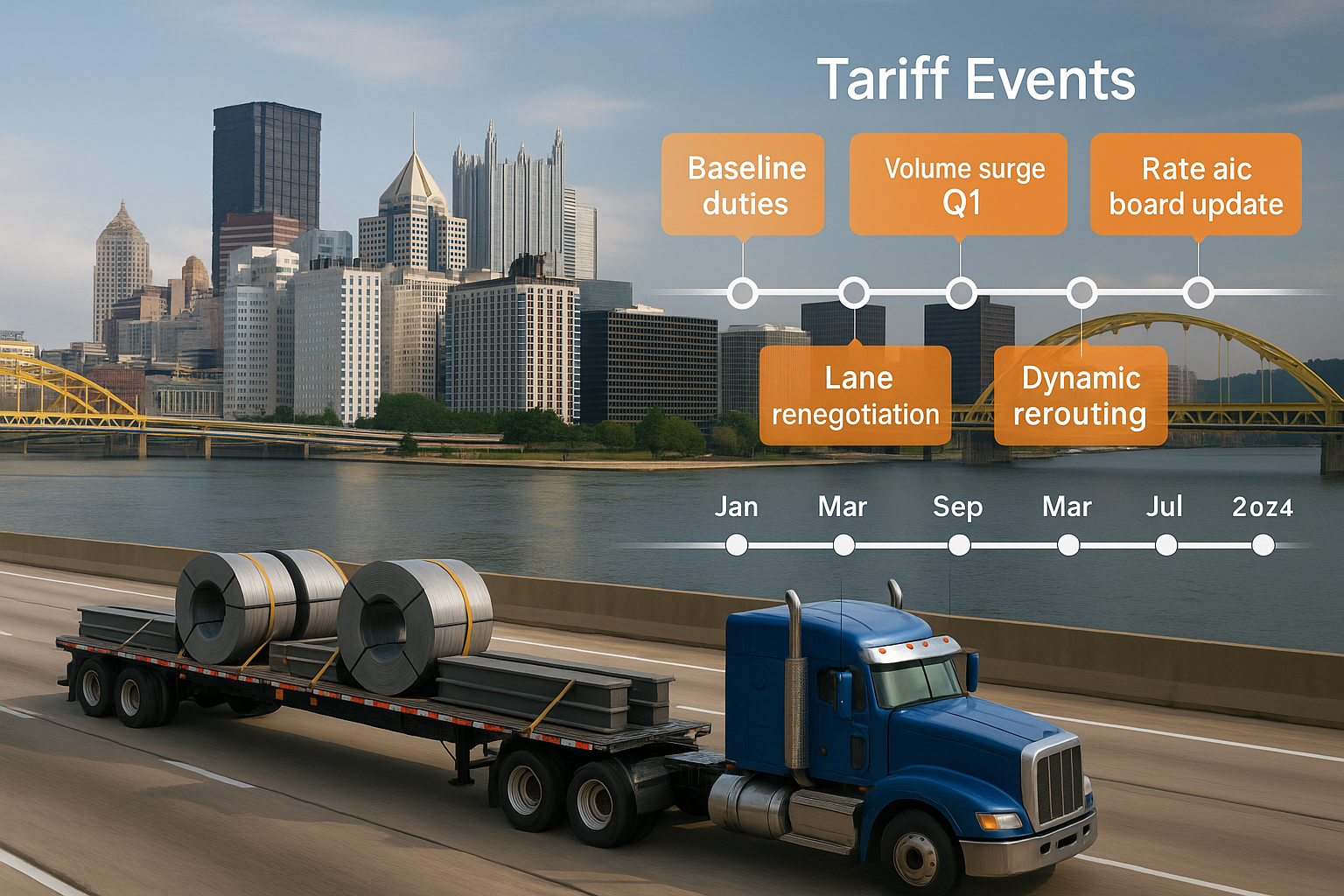
Table: Sample Tariff Timeline & Key Actions
| Date | Tariff Event | Key Action |
| Jan 2024 | Baseline duties published | Run cost analysis and update models |
| Mar 2024 | Volume surge Q1 starts | Apply load prioritization protocols |
| Jul 2024 | Contract lanes renegotiation | Deploy new rate adjustment strategies |
| Oct 2024 | Carrier rate boards updated | Set alert thresholds for rate spikes |
| Jan 2025 | Network balancing review | Enable dynamic rerouting workflows |
The table indicates that plotting duty changes to operational levers is the only possible way to escape the usual unwelcome surprises.
Real-Time Pittsburgh Tariff Tracking
“Set it and forget it” is not the best approach when it comes to handling Pittsburgh tariff tracking. What’s better is a multifaceted one that includes both automatic alerts and manual checks.
- Alert Thresholds
– Attach a software or set of dashboards from the carrier to flag rate or duty-announce deviations from a planned percentage (for example, 5% over contract lanes). - Carrier Rate Boards
– Always follow the public boards of leading flatbed steel carriers. You should stay updated on market trends even when booking lanes with contractual pricing as the spot rates will often indicate possible future market shifts. - Dispatch Scheduling Integration
– Tie your tariff monitor to the dispatch calendar. This way, schedulers will not tend to loads on tariff hike days.
The main aim is to combine dispatch scheduling with automated triggers in order to help you avoid potential cost spikes that can affect your P&L.
Cost Analysis and Rate Adjustment Strategies
The operation of flatbed budget management in civil steel is not merely bookkeeping — it’s a proactive preventative. Here are three strong cost reduction techniques:
Layered Contracting
– A quarterly bucket technique for annual volume is used. When the tariff rises in mid-year, the renegotiation of the rates that need to be done pertains just to the next quarter while the previous lanes remain unaffected.
Surge Penalty Credits
– You can add credits in the contract: in case the carriers carry out or surpass the contracted volume even though a volume surge happens, they will earn a small bonus; in other cases, they will take a share of higher duty costs.
Indexed Rate Tiers
– Rates may be correlated with a public road price, or government-duty tax index. Adjusting the index results in the rates, however, going up or down only if the previously agreed limits are still applicable.
You could apply targeted load prioritization for high-margin or time-sensitive shipments by using this method, which includes pushing lower-margin coils to standard contract lanes in the period when the duty pressure is at its highest.

Dynamic Rerouting for Network Balancing
When the principal flatbed partner is not able to bear the sudden tariff-driven spike, dynamic rerouting could act as a lifesaver. Let’s say that your key route from Cleveland to Pittsburgh faces a sudden 15% duty hike overnight. Instead of just stopping shipments, you can:
- Assess Alternate Gateways
– Try some secondary rail-to-truck yards that are not in zone 232 to avoid the problem and then use short flatbed hauls to pick the loads. - Leverage Regional Hubs
– Operate with other dispatch hubs nearby — for example, Youngstown or Columbus — to move coils from smaller trucks which are not included in the same tariff bracket. - Balance Lane Density
– Shift the under-used contracted lane from incoming to outgoing to balance out the capacity and thus decrease per-mile charges.
The plan is to reach network balancing: keep equipment moving and costs predictable, even if the primary tariff route becomes tighter.
Dispatch Scheduling Best Practices
Dispatch scheduling management can be done effectively by using the following tips:
- Block Booking: Reserve blocks of equipment long in advance for the lanes most exposed to duty changes.
- Calendar Flags: Mark duty announcement dates in your TMS calendar; if possible, block shipments around these dates.
- Rate Freeze Windows: Agree on short freeze periods which follow the tariff announcement, thereby locking carriers into pre-announcement rates for a certain number of days.
When the dispatchers comprehend the tariff movement, they will be able to program the hauls during times of cost inflection, and thus protect the margins on the costly steel loads.
Monitoring and Adjusting with Carrier Rate Boards
Carrier rate boards are not just for spot shippers. Even though most of your freight moves using long-term contracts, rate boards grant you:
- Market Sentiments Signals: A possible sign that the carriers see lasting cost pressures ahead.
- Benchmark Data: Useful information that can help you adjust the contract negotiations on contract lanes.
- Negotiation Leverage: “Carrier X has spot rates up 12% — let’s discuss adjusting our tier structure accordingly.”
Window dashboards to draw carrier rate board data into your analytics platform, which means overlaying public rates with your proprietary cost models on those dashboards.
Alert Thresholds: Staying Ahead of Spikes
Instead of going manual and manually scraping sites, automate alert thresholds for:
- Duty announcements: Government trade offices usually send out bulletins — so subscribe, parse, and tie them to your TMS.
- Steel price movements: Spikes in raw-material prices also lead to penalties or increased volumes.
- Carrier capacity alerts: If carriers publish ratios of load-to-truck that are above a certain level, reprice or re-tender lanes.
A three-tier alert system — Info, Warning, Critical — lets you focus on what’s more pressing. For example, an Info alert could be a plain notification to the planners, whilst a Critical alert can lead to re-routing or rate re-negotiation straightaway.
Cost Analysis Dashboards
Creating a simple cost analysis dashboard will assist you in visualizing how tariffs are impacting your margin. Some key metrics are:
- Effective cost per ton-mile: Tariff cost + linehaul rate.
- Quarterly spend vs. budget: Show over/under by lane.
- Surge impact metrics: Adds costs during high-volume times.
A pivot table description based on the origin, destination, and tariff added rates will effortlessly point out where the main exposure lies and will thus direct your next negotiation efforts.
Wrapping Everything Up
Through fusing Pittsburgh tariff tracking, smart rate adjustment strategies, and operational levers like dynamic rerouting and dispatch scheduling, shippers can successfully dispel the confusion of flatbed steel shipments. Take note of the following:
- Plot your tariff timeline and connect it to the critical actions.
- Automate alert thresholds and regularly scrape carrier rate boards.
- Negotiate flex tiers—layered contracts and indexed rates—to share the risk.
- Use cost analysis dashboards for constant and updated visibility.
- Sustain your network with real-time reroutes and alternative gateways.
By creating such a scheme, which is supported by tools and clear-cut processes, you will never be blindsided by a tariff change. If you also cooperate with those carriers who have a clear understanding of these strategies, like HMD Trucking, you will outshine others in transitioning steel through Pittsburgh’s demanding environment. Visit their dry van CDL jobs Cincinnati page to learn more about flatbed operations in Pittsburgh.
Managing tariffs, in the end, is not a one-off project but a continuous practice. Adopting these methods and linking them to your operational rhythm, your flatbed operations will keep being resilient and cost-efficient regardless of the surprise changes that the next tariff announcement may lead to.